A pool pump not working is one of the fastest ways to send a commercial facility or a homeowner into a panic. Knowing why your pool pump is not working before you call a technician can save time and money. After years servicing pools across the country, our team at Deep Blue Pool & Spa has narrowed it down to seven causes we see repeatedly. Here’s what to look for and how to address each one.
1. The Pump Has No Power
This sounds obvious, but it’s the first thing to verify. Check the circuit breaker dedicated to the pump if it’s tripped, reset it and observe whether it trips again immediately. A breaker that keeps tripping is a sign of a deeper electrical fault, not a one-time surge. Also inspect the GFCI outlet if one is present. A nuisance trip from moisture is common, especially in outdoor installations.
Fix: Reset the breaker or GFCI. If the problem repeats, contact a licensed electrician before running the pump again.
2. The Pump Won’t Prime
If the motor runs but water isn’t moving, the pump likely lost its prime. This typically happens after the system sits idle, following maintenance, or when the water level drops below the skimmer intake. Air trapped in the pump housing prevents suction. A swimming pool pump not working due to priming failure is extremely common and usually straightforward to correct.
Fix: Turn off the pump. Remove the strainer lid, fill the housing with water, replace the lid, and restart. Run the pump for 60–90 seconds to see if flow establishes.
3. Clogged Strainer Basket or Impeller
Debris accumulates faster than most people expect especially in high-use commercial settings. A clogged strainer basket restricts water flow into the pump. If debris gets past the basket, it can jam the impeller, causing the motor to labor or shut down on thermal overload. Both scenarios will leave you wondering why your pool pump is not working when the motor itself is fine.
Fix: Power off and depressurize the system. Remove and clean the strainer basket. If you suspect an impeller clog, the pump housing will need to be opened and the impeller cleared manually.
4. Air Leak on the Suction Side
Air leaks on the suction side are silent troublemakers. You’ll often notice air bubbles returning through the return jets a clear indicator the pump is pulling air rather than water somewhere upstream. Common entry points include a loose or cracked strainer lid O-ring, a failing shaft seal, or a loose union fitting. Left alone, this reduces hydraulic efficiency and stresses the seal.
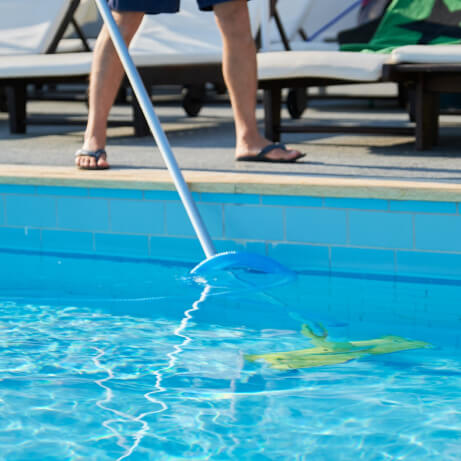
Once the leak is fixed and flow is restored, it’s a good time to vacuum pool to waste and clear any debris that built up during the downtime.
Fix: Inspect all fittings and unions on the suction side. Replace O-rings and shaft seals as needed. Use a product-safe lubricant on new O-rings to ensure a proper seat.
5. Motor Overheating or Burning Out
If the motor hums but the shaft doesn’t spin, or if it shuts off on its own after running briefly, thermal overload protection is doing its job. This can be caused by a seized impeller, a failed capacitor (common on single-phase motors), or simply poor ventilation around the motor housing. Running a pump dry even briefly can cause significant internal damage.
Fix: Allow the motor to cool for 20–30 minutes before restarting. If the issue persists, test the capacitor. A motor that repeatedly overheats likely needs professional evaluation or replacement.
6. Incorrectly Positioned Valves
This one catches facility managers off guard after routine maintenance. A multiport valve left in the backwash or closed position, or a suction valve that’s partially shut, can starve the pump of flow. The pump runs, nothing circulates, and the root cause is simply a valve handle that wasn’t returned to the correct position. It’s an easy miss during a busy maintenance window.
Fix: Walk the full plumbing circuit and confirm every valve is in its correct operating position before starting the system.
If manual operation works but the automated cycle doesn’t, it’s time to bring in a qualified commercial pool service company for a full controls diagnostic.
7. Faulty Timer or Control Board
Automated pool systems depend on timers and control boards to initiate pump cycles. A failed relay, a programming error after a power outage, or a defective circuit board can result in a pool pump not working on schedule or at all. This is particularly relevant in commercial facilities with complex automation systems where a single component failure can affect multiple functions.
Fix: Verify timer programming is intact. Test whether the pump starts manually. If manual operation works but the automated cycle does not, the control board or timer is the likely culprit and should be inspected by a qualified technician.

When to Call a Professional
Most pool pump issues come down to one of these seven causes. Working through them systematically starting with power, then flow, then mechanical components resolves the majority of cases without a service call. But when you’ve checked the basics and the pump still won’t cooperate, the cost of prolonged downtime outweighs a professional diagnosis.
Deep Blue Pool & Spa, INC specializes in commercial and residential pool equipment service across the US. Contact our team today to schedule a pump inspection or get expert support before a minor issue becomes a major repair.


Comments are closed