
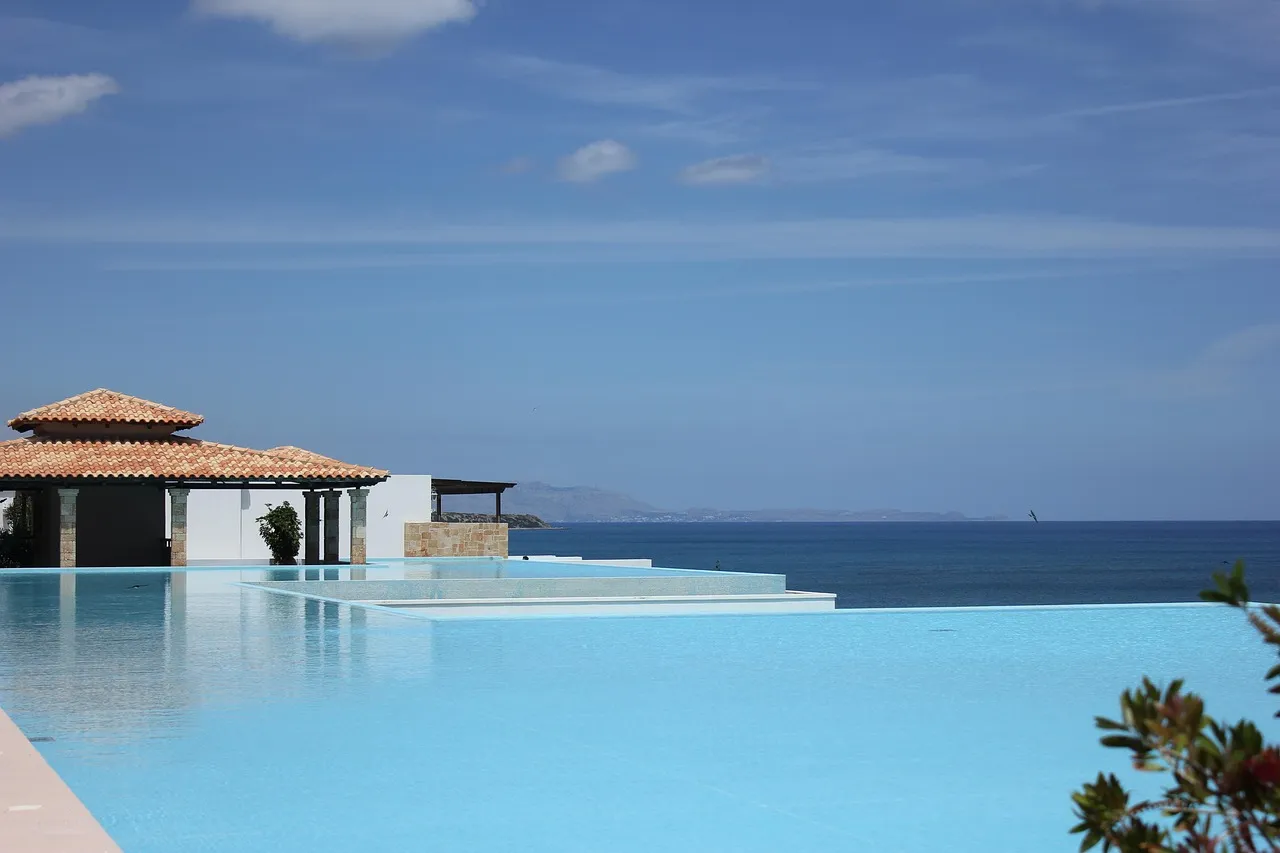
A disappearing edge swimming pool, commonly known as an infinity, negative edge, or zero edge pool, is designed to create a visual illusion where water appears to flow endlessly into the horizon
If you are in your backyard and see a sheet of water that doesn’t just end at a plastic or concrete rim, but instead flows seamlessly into the sky or the surrounding landscape. This is the magic of the disappearing edge swimming pool.
Often referred to as the Pool That Never Ends, these installations have become the gold standard for luxury residential design. Whether you are working with a steep hillside or a flat lot with a stunning view, a vanishing edge transforms a simple swim into an immersive experience. However, beneath that tranquil, glass-like surface lies a complex system of engineering and precise design.
In this guide, we will explore how do infinity edge pools work, the specific advantages of a vanishing edge fiberglass pool, and why these custom pool ideas are currently dominating the market.
Common Variations of Disappearing Edge Pools
Infinity Edge Pool
The most common variation, where one or more sides of the pool appear to vanish into the distance. This design works best when positioned toward a scenic backdrop such as water, mountains, or an open landscape.
Knife Edge Pool
A modern, minimalist version where water spills into a narrow perimeter slot. The pool surface sits perfectly level with the deck, creating a sleek “sheet of glass” effect that looks clean and architectural.
Movable Floor Pool
A high-tech variation where the pool floor can be raised mechanically to completely hide the water. When lifted, the area becomes a flat patio surface, making it ideal for multifunctional outdoor spaces.
How a Vanishing Edge Swimming Pool Works
At first glance, it looks like a defiance of physics, as if the water is simply falling off the edge of the world. In reality, the “disappearing” effect is a clever trick of hydraulic engineering.
The Weir Wall
Every disappearing edge swimming pool has at least one wall that is built slightly lower than the others. This is called the “weir” wall. While the other three or four sides of your pool are standard height, this specific wall is lowered by a fraction of an inch. As the pool’s primary pump moves water, it pushes a thin, constant layer over this lowered edge.
The Catch Basin
Once the water spills over the weir wall, it doesn’t just vanish into the ground. It falls into a hidden structural trough known as a catch basin or “holding tank.” This basin is the real workhorse of the system. It captures the overflow, filters it to remove debris, and then uses a high-powered pump to send the water back into the main body of the pool.
The Illusion of Stillness
The reason it looks like a Pool That Never Ends is that the water is constantly moving, but the surface remains perfectly still. Because there is no “lip” or “rim” for waves to bounce off of, the water appears to be a solid sheet of glass extending toward the horizon.
Why are Infinity Edge Pools So Popular?
You might wonder why homeowners choose to invest significantly more in a disappearing edge swimming pool cost compared to a standard rectangular pool. The answer lies in the combination of aesthetics and atmosphere.
- Unmatched Visuals: If your property overlooks a lake, an ocean, or even a beautiful valley, a standard pool wall acts as a visual barrier. An infinity edge removes that barrier, merging your private oasis with the natural world.
- Soothing Soundscapes: These pools aren’t just for looking at; they are a treat for the ears. The sound of water spilling over the edge into the basin mimics a natural waterfall. This acts as one of the most effective water features available, helping to drown out street noise or neighbors.
- Modern Architecture: These designs complement modern, minimalist, and contemporary home styles. They are the ultimate statement piece for Custom Pool Ideas.
- No “Dead” Water: Because the water is constantly overflowing and being filtered through a secondary basin, the surface of an infinity pool is often cleaner than a standard pool, as floating debris (like leaves or bugs) is quickly swept over the edge.
Key Takeaways
- Engineering is Key: These pools require specialized structural calculations to ensure the weir wall remains perfectly level over time.
- Site Selection: They work best on sloped lots where the “drop-off” can be hidden from view.
- Maintenance: Expect slightly higher water and chemical usage due to the increased evaporation caused by the falling water.
- Value: While the initial disappearing edge swimming pool cost is higher, the ROI on property value is typically much higher than a standard pool.
Built Different: Ecopool Infinity Pools
When most people think of a disappearing edge swimming pool, they imagine months of messy concrete construction. However, the industry has evolved. Ecopool Infinity Pools have changed the game by offering modular and shipping container-based designs that are “built different.”
Why Ecopool?
Traditional concrete infinity pools can take 6–12 months to complete. Ecopool designs are engineered in a controlled factory environment. This allows for a vanishing edge fiberglass pool or steel-lined finish that is far more durable and precise than hand-poured concrete.
Because the leveling of the Infinity Pool Edge Design must be accurate to within millimeters, the factory-controlled setting of an Ecopool ensures that your “vanishing” effect is perfect from day one. Additionally, these pools are often more sustainable, using recycled materials and requiring less heavy machinery on your property during installation.
Custom Pool Ideas: Beyond the Basics
If you are looking to elevate your backyard further, consider these Infinity Pool Edge Design variations:
- The 360-Degree Overflow: For a truly “island” feel, the water can disappear on all four sides into a hidden perimeter slot.
- Integrated Hot Tubs: Elevate a spa in the center of the pool so it spills over into the main pool, creating a multi-level Water Feature.
- Glass Walls: Combine a disappearing edge with a transparent acrylic wall for a “window” into the pool.
Frequently Asked Questions
How much does it cost to get a disappearing pool?
The disappearing edge swimming pool cost generally starts around $80,000 but can easily exceed $150,000 depending on the terrain. You aren’t just paying for a pool; you are paying for two structural shells (the pool and the basin), extra pumps, and specialized engineering.
How much does infinity edge add to pool cost?
Typically, adding a vanishing edge to a standard pool project will add 30% to 50% to the total price tag. This accounts for the secondary catchment tank and the reinforced wall required to hold the weight of the water.
How does a disappearing swimming pool work?
It uses a recirculating system where water flows over a slightly lower wall (the weir) into a collection trough. A pump then moves that water back into the main pool to keep the cycle going.
What are the drawbacks of zero entry pools?
It is important to note that zero entry pools are different from infinity pools. A zero entry pool has a sloped “beach” entrance. The main drawbacks are that they require a massive amount of square footage to achieve the slope, and the shallow entry point can often collect more debris and warm up too quickly, leading to algae growth if not managed.
Can you have a vanishing edge fiberglass pool?
Yes! While difficult to execute with traditional pre-molded shells, modern manufacturers like Ecopool create specialized frames that allow fiberglass finishes to function perfectly with a vanishing edge, giving you the smooth feel of fiberglass with the luxury look of an infinity edge.


Comments are closed